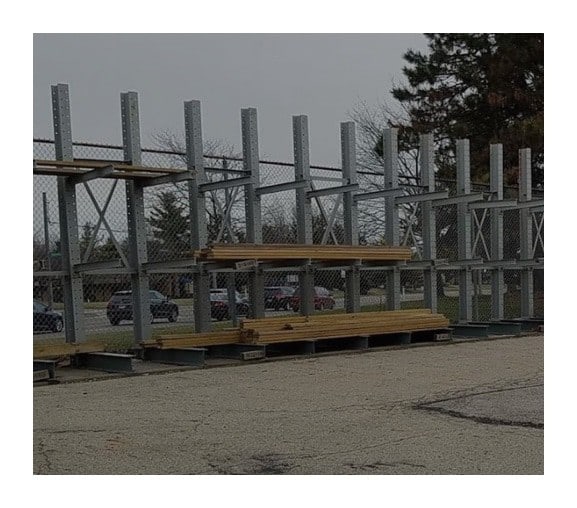
Cantilever racks are the perfect storage solution for bulky or long items. Think lumber, furniture, pipes, tubing, and other unwieldy loads. These uniquely shaped racks make storage, loading, and unloading quick and easy.
Most rack options can easily accommodate items if the load is a standard size, such as with palletized loads and selective pallet racking. But not all products are standard sizes.
A sofa wouldn’t fit in a bay designed for a 40” x 48” pallet. Nor would a 4’ x 8’ sheet of gypsum, a stack of lumber, or pipes.
But cantilever racks are the perfect solution. This type of racking consists of a base bolted to a vertical beam with horizontal arms attached to hold the products.
Cantilever racking has great clearance. And you can load and unload it in several ways — with forklifts, hoists, stackers, or by hand.
You can easily configure cantilever storage solutions to meet your warehouse’s changing needs. You can use them in an open design or with added decking to store different-sized products.
While these racks may not always look exceptionally sturdy, some types of cantilever racking can accommodate load capacities of up to 20,000 pounds per arm.
Cantilever racks do have a few disadvantages, though. For example, they are not the right choice for pallet storage. And they require more space because there needs to be an aisle between every rack.
There’s also the cost consideration — designing and installing cantilever racking can be more expensive than other types of racking. However, when you need to store irregularly shaped or bulky items, there is no replacement for cantilever racking.
Cantilever racks solve problems in environments where standard pallet racking falls short. Here are some of the most common applications for cantilever racking:
Cantilever racks are a near-perfect solution for storing long pieces of lumber, plywood, sheetrock, and steel studs.
When you're storing couches, mattresses, or boxed furniture, cantilever racks give you the unobstructed space you need.
Whether it's metal, plastic, or PVC, long cylindrical items like pipe and conduit store best on inclined cantilever arms that prevent rolling and product damage.
Raw materials like bar stock, rebar, beams, and extrusion profiles are easy to store on cantilever racks — especially when you add decking for mixed load types.
Rolled materials like carpet, vinyl, and fabric are heavy and awkward to store on standard shelving. Cantilever systems, on the other hand, support the length and weight of these items — all while keeping them off the floor and easy to access.
Big box stores and warehouse-style retailers use cantilever racks to store bulky seasonal items, fencing materials, and even garden equipment. This keeps your aisles clear and your products visible.
There are two types of basic arms for cantilever racks:
Here’s a closer look at each arm type:
Straight arms can store flat items like sheets, lumber, and any other items that need a level surface. They tend to have a slight upward pitch.
Inclined arms generally store pipes, tubing, or any similarly round-profile item. These arms also have an upward pitch, but the angles are generally more pronounced to keep the products in place.
Cantilever racks are useful in many situations, but the arms and configuration you choose have to be strong enough to support materials you intend to store.
Deflection (sagging) is a concern with cantilever racks. The products on the racks need to have adequate arm support to prevent deflection. That means it’s important to determine the exact product weight and length before placing it on the rack.
Flexibility is a key benefit of cantilever racking because you can easily configure it to meet changing needs.
Cantilever racking’s open design allows forklifts to easily access products that can be challenging to handle. The rack does not obstruct the view, as is often the case with pallet racks.
That creates fewer issues with clearance and allows workers to locate and retrieve products faster. Translation: You save time and money. Another time- and money-saver is adding decking to the rack. Typically wood, wire, or steel, cantilever decking allows you to store products of multiple sizes, including palletized loads.
Cantilever racks have no columns to obstruct the movement of loads. That makes them ideal for long, uncommonly shaped items.
Typical products cantilever racking can store include the following:
These racks are available in multiple sizes, from six feet in length to more than 30 feet. Arm lengths also vary and are available up to six feet long, accommodating products of many dimensions. Rack configurations include one- and two-sided racks. Two-sided racks allow for higher product density.
Cantilever racks are subject to heavy loads and forklift impacts, so you need to inspect them at least once a year. Inspectors should look for damaged arms, bases, or posts and tighten all bolts and hardware.
If you find any damage or loose anchors, unload the rack immediately and until you resolve the issues.
The simplest way to ensure safe use of your cantilever racking system is to design the rack to the correct specifications and not overfill it at any time. Your cantilever rack should be specified to handle the size, shape, and weight of the loads you plan to place on it.
The arms of a cantilever rack are prone to damage. If a forklift driver hits the arms when placing a load, that could spell bad news for the longevity of your racking.
Always center the load and make sure it’s parallel to the ground when placing or removing. That helps you ensure an even load across the arms.
Increasing aisle clearance between cantilever racks is a great way to reduce the chances of a forklift hitting and damaging the structure. Adding tolerance in areas where collisions are possible will also extend the safety and life of your racks.
We highly recommend consulting a storage solutions professional for system design and installation if you need cantilever racks for your space. Fortunately, we offer both cantilever system design and installation backed by decades of experience.
The experts at East Coast Storage Equipment can guide you through the cantilever rack selection process/ We’ll make sure your final configuration maximizes your warehouse’s efficiency and is perfectly suited to your specific needs.
Input your search keywords and press Enter.