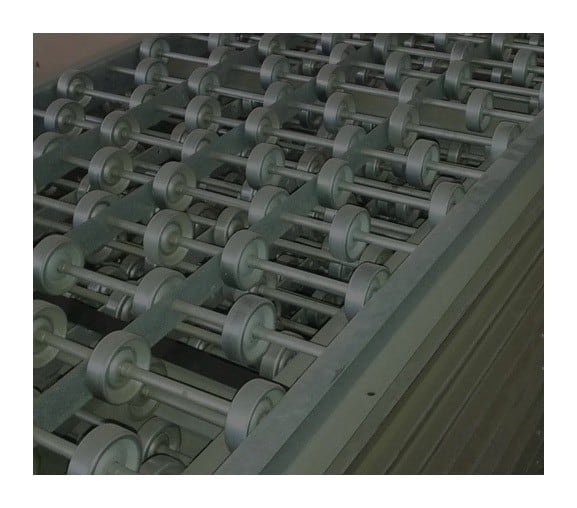
Gravity conveyors are a cost-effective and versatile transportation solution on warehouse floors throughout the world. They harness the natural force of gravity to move items. They optimize for efficiency and minimize labor — all without wires or electricity.
These non-powered material handling solutions are highly customizable. They often integrate with other warehouse systems like carts and scales for streamlined picking, packing, and other transport-related applications.
Gravity conveyors are set on a slope and use momentum to push loads down the line. Unlike a powered conveyor, which requires a power source to generate movement, gravity conveyors allow items to flow freely.
The roller device
There are two main types of roller devices for gravity conveyors:
Roller conveyors use tube-shaped rollers connected to the frame. The rollers rotate to enable forward movement. They are typically most useful for heavier loads.
Skatewheel conveyors use a system of small, round wheels that rotate as the load moves across. These are often best for high-volume, low-weight items. That makes them particularly useful in the food and beverage industries.
Keep in mind that many bend, curve, and merge conveyors can also use the gravity method.
Thanks to their streamlined setup, gravity conveyor systems are cost-effective compared to powered conveyor solutions. And they’re highly versatile.
You can also configure these non-powered conveyors to your precise specifications. That makes them helpful for both light-duty and heavy-duty operations across various industries, including warehouses, distribution centers, and manufacturing facilities.
When it comes to purchasing the right conveyor system for your facility, you’ll need to keep several key factors in mind. Don’t mistake the simple construction of a gravity conveyor system for an excuse to not pay close attention to these considerations:
Rollers are critically important because they are in direct contact with the load.
The type of roller you choose will depend on the product you’re moving (weight, size, and material), as well as facility conditions.
For heavier products, steel tube rollers are often the best choice thanks to their durability and load-bearing capacity. Lighter items, on the other hand, may work well with smaller-diameter or plastic rollers, which help reduce noise and cost.
You’ll also want to consider factors like moisture, temperature, and potential debris — for example, sealed bearings are ideal in dusty or damp environments.
To keep your product safe, at least three rollers must always be in contact with the load.
That means the spacing between rollers — known as the roller centers — has to match the length and bottom surface of your product. If the rollers are spaced too far apart, smaller items can tip, get stuck, or fall through.
The frame is the backbone of the conveyor. It has to support the weight of the mechanism and the product being moved.
Factor product and location specifications into your overall capacity calculations.
Roller order settings refer to the position of the rollers relative to the frame.
There are two core options:
The right choice depends on the size, shape, and stability of your product. High roller settings are best for larger, more stable items because they make loading and unloading easier. Low roller settings are good for smaller or unstable items that might shift or fall off during movement.
Conveyor slope is the pitch or incline of the gravity conveyor. It determines the flow rate and speed of the products down the line.
The proper slope depends on numerous factors, such as the product (size, weight, surface area) and the roller type (size, configuration, spacing).
Heavier items, for example, often need a gentler slope to avoid going too fast. Meanwhile, lighter products or those with more surface friction may need a steeper incline to keep them moving. Testing is often the best way to fine-tune the slope on your gravity conveyor.
Still wondering what type of gravity conveyor will suit your facility best? The perfect place to start is understanding the load you need to transport. Your product plays a key role in shaping the type, size, configuration, and operation of the conveyor you purchase.
Take note of your product’s size, weight, and surface area. For optimal conveying, unit loads should have a flat, stable surface. Avoid irregular or broken boards, protruding nails, and loose items. Use tote boxes, carrier boards, or pallets for smaller or oddly shaped items.
There are several different load types. Each will demand different slope, capacity, and conveyor configuration. A few common load types include:
Operating conditions also play a role in your understanding of your gravity conveyor needs, especially as it relates to bearings:
Get in touch with the East Coast Storage Equipment team if you have any questions.
If you want to know which kind of gravity conveyor is right for your business, call our team at 888.294.5022. Our material handling equipment experts are ready to help you find the perfect gravity conveyor for your business.
While most conveyor sections come preassembled, you still need to follow certain standards as you install them.
First, always install equipment according to the elevations shown in the layout drawings. Setting the initial first elevation is critical to setting the rest of the points. A mistake here will lead to more trouble down the line.
Consider adjustments for floor level changes, like moving to an upper or lower floor. Always install anchoring according to the manufacturer’s instructions.
Run the conveyor with a moderate load and observe the products as they travel along the entire length of the system. Listen for abnormal noises or vibration from the conveyor’s bearings and rollers.
Address any issues right away. And make sure the supports are properly aligned to achieve the product flow and orientation you want. Remove any dirt buildup on the skatewheels or rollers that could hinder smooth operation.
Finally, inspect the wheels or rollers for signs of damage. Replace any faulty components immediately.
With fewer parts comes less maintenance — that’s the good news. However, gravity conveyors still need a regular maintenance cycle to extend their shelf life, comply with regulations, and keep your products and people safe.
A good rule of thumb is to inspect rollers, frames, and fasteners monthly. And do a more thorough check — including cleaning and lubrication where applicable — every three to six months, depending on how much you use the system.
Even with a strict maintenance and inspection schedule, you will eventually need to replace or repair your gravity conveyor system.
If your system needs a refresh, contact our experienced team at East Coast Storage Equipment. We’re always happy to help.
Gravity conveyors’ simple design and operation offer a key benefit: limited maintenance needs.
While regular inspections are still critical, the self-contained nature of a gravity conveyor system — whether that’s a skatewheel or roller unit — means most maintenance revolves around periodic part replacements and regular lubrication. This includes a general inspection of the equipment and checking all nuts and bolts for proper tightness.
While you should always consider local and Occupational Safety and Health Administration (OSHA) standards, here are some general guidelines for ongoing mechanical maintenance for gravity conveyors:
Periodic lubrication. Monthly
Check for unusual noise or excessive wear, and replace as required. Weekly
Periodic lubrication. Monthly
Make sure supports have not been damaged and fasteners are correctly secure: Weekly
Make sure all fasteners are in place and adequately tightened (at setup and every week of operation)
While these systems can last a very long time, understanding when to replace your conveyor system is essential for not only employee safety but also for the safety of your inventory.
Whether you need help with equipment layout and design or just the installation, East Coast Storage Equipment delivers turnkey gravity conveyor solutions to your warehouse floor. Get in touch with our experienced team of storage and material handling experts today to learn more.
At East Coast Storage Equipment, we carry a wide selection of gravity conveyor systems and can assist with the design and installation process.
Our experts are on standby to help you with every step.Contact us today to learn more about your options.
Input your search keywords and press Enter.